Champion 201319 vs Westinghouse iGen4500
Quick answer
Buy the Champion 201319. On paper the Westinghouse iGen4500 is the better generator — 200 W more running power, a much quieter published noise figure, remote start, and a longer runtime on a tank of gas. But you probably can't buy one new right now: Westinghouse has delisted it from its own store, it is out of stock at Norwall, and its successor (the iGen5000) has taken its place. The Champion is in stock, $999, runs on gasoline or propane, and carries CO Shield auto-shutoff — and for a home-backup generator, dual fuel matters more than the Westinghouse's extra 200 W. If you do find a new iGen4500 in stock near its old $899 price, take it for the quiet. Otherwise the Champion is the pick.
Check price: Champion 4500 Dual Fuel Inverter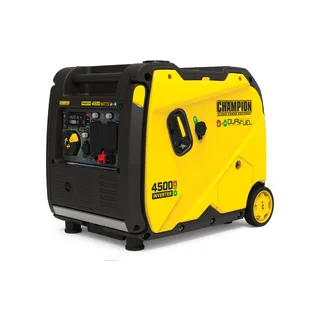 Check price: Westinghouse Igen4500
Head to head
| Spec | Champion 201319 | Westinghouse iGen4500 |
|---|---|---|
| Starting watts | 4,500 | 4,500 |
| Running watts | 3,500 (gas) / 3,150 (propane) | 3,700 (gas) |
| Fuel | Gasoline or propane | Gasoline only |
| Noise (published) | 61 dBA from 23 ft | 52 dBA, "as low as" (load and distance unstated) |
| Weight | 99.2 lb | 98 lb |
| Fuel tank | 2.3 gal | 3.4 gal |
| Runtime at 25% load | 14 hrs (gas) / 21 hrs (20-lb propane bottle) | 18 hrs (gas) |
| Starting | Electric (recoil backup) | Electric, remote, recoil |
| RV outlet | 120V 30A TT-30R | 120V 30A TT-30R |
| CO shutoff | CO Shield (standard) | Not published for this model |
| Parallel-capable | Yes (kit sold separately) | Yes (kit sold separately) |
| Warranty | 3-year limited + free lifetime tech support | 3-year residential / 1-year commercial |
| Price (see note) | Around $999 | Around $899 last price — see availability |
| Availability | In stock | Delisted at the maker; out of stock at Norwall |
Prices are the manufacturers' published prices from our dataset, not Amazon prices. Champion's $999 is the Norwall price (Northern Tool lists $1,022.99), checked 2026-11-17. The Westinghouse's $899 is its last listed price; Norwall now lists $1,029 and shows it out of stock, re-checked 2026-11-18. Specs are the manufacturers' own published figures, cross-checked the same days. Neither generator is 240V — both are 120V only, so neither runs a 240V well pump or feeds a 240V inlet box. Our portable generator roundup covers the full field, including the 240V options.
Output: a 200 W edge that rarely matters
The Westinghouse's headline advantage is 3,700 running watts against the Champion's 3,500 on gasoline — 200 W, or about 6%. Both start at 4,500 W, both will run a fridge, a furnace blower, lights, and a router at the same time, and both will start most 15,000 BTU RV air conditioners. The 200 W only bites at the margin: a second big load (a microwave on top of the fridge, a coffee maker while the furnace runs) is where the Westinghouse's headroom shows. On propane the Champion drops to 3,150 running watts, so a propane-only buyer gives up 550 W against the Westinghouse on gas — the price of fuel flexibility, and worth knowing before you commit to propane as your stored fuel.
Noise: the Westinghouse wins, with a measurement asterisk
The published figures say 52 dBA against 61 dBA, and that gap is big enough to hear from across a yard — 9 dB is roughly twice as loud to the ear. But the two numbers aren't measured the same way, and the page should say so. Champion states 61 dBA from 23 feet but doesn't state the load. Westinghouse says "as low as 52 dBA" and states neither the load nor the distance. The honest read: the Westinghouse is the quieter machine — it is the quietest published figure in this size class, and its remote start means you can park it farther from the house and still start it from inside — but don't treat "52 vs 61" as a laboratory comparison. If overnight noise near bedrooms is the deciding factor, the Westinghouse is the one to hunt for; if it's not, the gap shouldn't decide the purchase.
Fuel: the Champion's dual fuel is the real difference
This is the round that decides the page. The Champion runs on gasoline or propane, switched with an EZ Start dial: 3,500 running watts on gas, 3,150 on propane, up to 14 hours on its 2.3-gallon tank or up to 21 hours on a standard 20-lb propane bottle at quarter load. Propane stores indefinitely, doesn't gum a carburetor, and is the fuel you can still buy when gas stations lose power — for a generator that may sit six months between outages, that is the practical advantage. The iGen4500 is gasoline-only. (Westinghouse sells dual-fuel variants, the iGen4500DF and iGen4500DFc, as separate models — this page compares the gasoline iGen4500, the one most buyers cross-shop against the Champion.)
On runtime per tank the Westinghouse looks better — 18 hours against 14 — but that's the bigger tank doing the work, not better efficiency: 3.4 gallons over 18 hours is about 0.19 gal/hr, against the Champion's 2.3 gallons over 14 hours at about 0.16 gal/hr. The Champion actually sips less per hour; the Westinghouse just carries more. Carry a spare gas can either way and the difference vanishes.
Starting, safety, and warranty
The Westinghouse starts three ways — remote fob, electric, recoil — against the Champion's electric and recoil. Remote start is a genuine convenience in bad weather: start the unit from inside, let it warm up, then walk out to plug in. The Champion answers with CO Shield, its carbon-monoxide auto-shutoff, which Westinghouse doesn't publish for the iGen4500 — and CO shutoff is the safety feature that matters most on a machine that gets run near a house. Both have a TT-30R RV outlet, both are parallel-capable with a kit, and both carry a 3-year limited warranty for home use (the Westinghouse drops to 1 year for commercial use). Champion adds free lifetime technical support, which its owners consistently cite. Weight is a wash: 99.2 lb against 98 lb, and both are two-person lifts with wheels and a folding handle.
Availability: the round the Westinghouse loses
The iGen4500 is the better generator on paper and the harder one to buy. Westinghouse has delisted it from its own store and points buyers to the iGen5000 ($1,099 list), and Norwall — the dealer that stocks both — lists the iGen4500 at $1,029 and out of stock, re-checked 2026-11-18. It remains listed on Amazon, where third-party sellers carry it, but the maker has moved on. The Champion 201319 is the current model — it replaced the delisted 200989 in November 2026 — and is in stock at Norwall at $999 and Northern Tool at $1,022.99. A generator you can't buy is a spec sheet, not a backup plan.
The verdict
Buy the
Check price: Champion 4500 Dual Fuel Inverterif you need a generator this week: dual fuel, CO Shield, in stock at $999, and the propane option is the one that keeps a stored generator ready through months of sitting idle. The 200 W you give up against the Westinghouse almost never decides an outage.
Buy the
Check price: Westinghouse Igen4500instead if you find a new one in stock near its old $899 price and noise is your deciding factor — it is the quietest 4,500 W-class inverter you can buy, with remote start and the longest gas runtime of the two. Just confirm it's the gasoline iGen4500 (not the DF dual-fuel variant) and that the seller is authorized, since Westinghouse's own store no longer carries it.
FAQ
Is the Westinghouse iGen4500 discontinued?
Westinghouse hasn't announced it that way, but the facts point there: it is delisted from Westinghouse's own store, its successor the iGen5000 is the model Westinghouse now lists, and Norwall shows it out of stock. Treat it as a model you may have to hunt for rather than one you can always order.
Which one is quieter?
The Westinghouse, on the published figures — 52 dBA against 61 dBA — but the two figures aren't measured under the same conditions, so the gap is directional rather than exact. The Champion's 61 dBA is measured from 23 feet; Westinghouse doesn't state a load or a distance for its 52.
Can the Champion run on propane only?
Yes. It produces 3,150 running watts on propane (against 3,500 on gasoline) and runs up to 21 hours at quarter load on a standard 20-lb bottle. If propane is your stored fuel, size your loads to the 3,150 W figure, not the 3,500 W one.
Can either one run a 240V well pump or feed a 240V inlet box?
No. Both are 120V-only machines. For 240V loads you need a 120/240V unit — the portable roundup covers the Firman P03631, the cheapest route to 240V backup in this price range.
What's the difference between the Champion 201319 and the 200988?
The 201319 is the current dual-fuel model with CO Shield; the 200988 is its gasoline-only sibling at the same 4,500 / 3,500 W ratings. The 200989 was the earlier dual-fuel model, delisted by Champion in November 2026 and replaced by the 201319. If a listing doesn't show the model number, check before you pay.
Related guides
- Honda EU2200i vs WEN 56235i
- Cummins vs Champion Standby Generators
- Generac vs Champion Standby Generators
- Kohler vs Champion Standby Generators