Kohler 20RCA vs Cummins RS20A
Quick answer
For most buyers, the Cummins RS20A. It is the quieter machine under load on the published figures — 65 dB(A) at a normal load against the Kohler's 70 dB(A) at full speed — its weekly exercise cranks the engine without starting it, so the test is near-silent instead of the Kohler's 66 dB(A) exercise run. It is also the smaller, lighter box (34.1 x 36 x 27.3 in, 531 lb against 47 x 26.2 x 32.2 in, 600 lb), it costs less to run on propane, and its Intelligent Load Management handles up to four heavy loads. And it costs essentially the same: $5,747.50 against $5,699, a $48 gap.
Buy the Kohler 20RCA instead if warranty breadth or dealer depth decides it. Kohler's premium warranty covers parts, labor, and travel for the full five years; Cummins covers travel and labor for two years and parts for five. Kohler also publishes a 10-second response time and includes OnCue Plus remote monitoring, and its residential dealer network is the deeper of the two. On output the two are a dead heat — the same 20 kW on propane, the same 18 kW on natural gas, the same 999cc V-twin displacement, and 41 vs 40 kVA of motor-starting — so buy on noise, warranty, and which dealer is local, not on the badge.
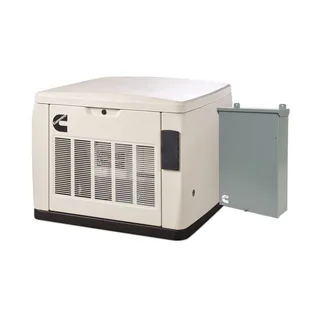
Check price: Kohler 20Rca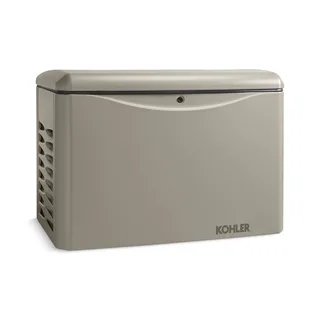 Check price: Cummins Quietconnect Rs20A
Head to head
| Spec | Kohler 20RCA | Cummins QuietConnect RS20A |
|---|---|---|
| Output on propane | 20 kW (83 A) | 20 kW (83.3 A) |
| Output on natural gas | 18 kW (75 A) | 18 kW (75 A) |
| Engine | Kohler CH1000, 999cc V-twin | Cummins QSJ999G, 999cc V-twin |
| Peak motor-starting | 41 kVA (35% dip) | 40 kVA (30% dip) |
| Sound, exercise | 66 dB(A) at 23 ft | Crank-only mode (engine cranks, doesn't start) |
| Sound, running | 70 dB(A) at full speed, per spec sheet G4-272 (older revision printed 64/69) | 65 dB(A) at 23 ft at normal load (3 kW) |
| Response time | 10 seconds (published) | Within seconds (dealer copy; no published figure) |
| Transfer switch | Sold separately (the 20RCAL bundles a 200A RXT switch) | Sold separately (the RS20AC bundles a 200A service-entrance ATS) |
| Load management | Load control modules via the RXT switch | Intelligent Load Management, up to 4 loads (kit sold separately) |
| Monitoring | OnCue Plus remote monitoring included | Cloud Connect app (free) |
| Battery | Group 51, 500 CCA (not included) | Group 51R, 450 CCA (not included) |
| Dimensions | 47 x 26.2 x 32.2 in | 34.1 x 36 x 27.3 in |
| Weight | 600 lb | 531 lb |
| Cold weather | Not published separately | Standard to 0°F; extreme-cold models to -40°F |
| Warranty | 5-year / 2,000-hr, parts + labor + travel | 5-year / 2,000-hr; travel + labor 2 yrs, parts 5 yrs |
| Price (see note) | Around $5,700 | Around $5,750 |
Prices are the manufacturers' published prices from our dataset, re-verified 2026-11-22 at Norwall — Kohler $5,699 in stock, Cummins $5,747.50 in stock — not Amazon prices. Kohler lists the 20RCA at $6,016 MSRP; the street price runs about $300 under that. Specs are the manufacturers' own spec sheets (Kohler G4-272, Cummins NAS-6254-EN), cross-checked the same day. Both units need a transfer switch and a battery bought separately, and both are equipment-only prices: installation, gas work, and permits are a separate bill, typically several thousand dollars. Our standby roundup covers the full field, and the size calculator checks whether 18–20 kW fits your house. The 14 kW version of this matchup is at Kohler 14RCA vs Cummins RS13A.
The natural-gas round is a tie this time
This is the finding that matters most, because it breaks the pattern from the 14 kW pair. At 14 kW the Cummins held its full rating on natural gas while the Kohler dropped a kilowatt — the result that decided that page. At 20 kW neither one holds it: both are 20 kW on propane and 18 kW on natural gas, 75 amps on either machine. So if your house sizes to 19 or 20 kW on natural gas, neither of these units does it — you step up to the 26 kW class, not across to the other brand. On propane both deliver the full 20 kW. Size to the 18 kW natural-gas figure if you're on gas, and treat the "20 kW" badge as the propane number.
Output and motor-starting: a dead heat
There is almost nothing between these two on power. Both run a 999cc V-twin — the Kohler CH1000 and the Cummins QSJ999G are the same displacement, both air-cooled, both at 3,600 RPM. Peak motor-starting is 41 kVA for the Kohler against 40 kVA for the Cummins, and the two figures aren't measured on the same dip basis (35% for Kohler, 30% for Cummins), so treat the 1 kVA gap as noise. Both makers say their machine starts and runs a 5-ton air conditioner, and both carry a 100% one-step load acceptance rating on their sheets. If a big central AC is the load that decides your size, neither machine has a paper case over the other — the deciding rounds are noise, warranty, and the dealer, below.
Noise: the published numbers aren't the same test
The Cummins looks quieter — 65 dB(A) against the Kohler's 70 dB(A) — but the two numbers are measured under different conditions, and the page should say so. Cummins rates the RS20A at 65 dB(A) at 23 feet at normal load, which its sheet defines as a typical 3 kW household draw. Kohler rates the 20RCA at 70 dB(A) at 23 feet at full speed, and 66 dB(A) during its weekly exercise. The honest read: the Cummins is the quieter one under load on the figures as published, and the gap is probably real — Cummins' QuietConnect enclosure is the quietest air-cooled design in the class by most independent measures — but don't treat 65 vs 69 as a laboratory comparison. One more wrinkle: Kohler's own spec sheet has been revised — the current G4-272 (10/24h) prints 66/70 dB(A), where the older revision printed 64/69. We use the current sheet's figures and note the disagreement rather than picking the friendlier numbers.
The bigger noise difference is the weekly exercise. The Kohler runs its engine every week at 66 dB(A) — audible from the yard, the same as a normal conversation at close range. The Cummins' patented crank-only exercise mode cranks the engine without starting it while the controller runs diagnostics, so the weekly test is near-silent and burns no fuel. If the unit sits beside a bedroom window or a neighbor's patio, the Cummins' exercise mode is the feature you'll notice every week, not the 5 dB running gap.
Fuel cost: propane favors Cummins, natural gas is nearly even
Same method as our size calculator: consumption from the makers' spec sheets, at $1.50 per therm for natural gas and $2.50 per gallon for propane, for 24 hours at half load.
| Fuel, 24 hrs at half load | Kohler 20RCA | Cummins RS20A |
|---|---|---|
| Natural gas | 161 cfh — about 39 therms, roughly $58 | 172 cfh — about 41 therms, roughly $62 |
| Propane | 2.25 gal/hr — about 54 gal, roughly $135 | 1.81 gal/hr — about 43 gal, roughly $109 |
On natural gas the two cost almost exactly the same to run — the Cummins burns about 7% more at half load, worth roughly $4 a day. On propane the Cummins is clearly cheaper: about $26 a day less at half load, because its smaller effective appetite (1.81 vs 2.25 gal/hr) outweighs the Kohler's edge. At full load for 24 hours the estimates are about $101 (Kohler) vs $96 (Cummins) on natural gas, and about $224 vs $185 on propane. These are estimates from published consumption figures, not metered bills — your load won't sit at half for 24 hours straight. The 14 kW story, where the Cummins burned far more natural gas, does not repeat at 20 kW: the two engines are the same size here, and the fuel math shows it.
Load management and monitoring
Both machines can shed heavy loads so a 20 kW unit can cover a house that occasionally peaks above it, but they package it differently. The Cummins' Intelligent Load Management is a named system: the controller learns the draw of up to four 240-volt loads (air conditioners, water heaters, dryers) and restores them only as capacity allows — the kit is sold separately and controls two loads per kit, so two kits cover four. The Kohler manages loads through control modules on the RXT transfer switch, also sold separately. If your house has two or more big managed loads, the Cummins' system is the more explicit one; if you have one big load, either approach works.
On monitoring, both are covered: the Kohler includes OnCue Plus remote generator management, and the Cummins' Cloud Connect app (free) checks status, programs exercise periods, and can start and stop the unit from a phone, sending performance data to your dealer. Neither charges a subscription for its app.
Warranty and what's in the box
Both carry a 5-year / 2,000-hour limited warranty, but the coverage isn't identical. Kohler's premium warranty covers parts, labor, and travel for the full five years. Cummins covers travel and labor for two years and parts for five. Over a 15-year ownership that difference is worth something if your dealer is far away — and Cummins' residential dealer network is the thinner of the two, which is the same caveat in both directions. Kohler offers 7- and 10-year extended warranties; Cummins lists extended warranties as available through dealers.
Neither price includes what you need to run it. Both need an automatic transfer switch bought separately — the Kohler 20RCA takes an RDT or RXT switch (the 20RCAL variant bundles a 200A RXT switch), the Cummins takes an RA-series switch (the RS20AC variant bundles a 200A service-entrance ATS) — and both need a 12-volt battery bought locally (Group 51, 500 CCA for the Kohler; Group 51R, 450 CCA for the Cummins). Budget for both, plus installation, gas, and electrical work, before comparing the unit prices. The Cummins' one packaging edge: its enclosure is rated for installation 18 inches from the home under NFPA 37, and the unit is wind-rated to 180 mph.
The verdict
Buy the
Check price: Cummins Quietconnect Rs20Aif you want the quieter machine under load on the published figures, the near-silent weekly exercise, the smaller and lighter box, the cheaper propane running cost, or the named four-load management system — at $48 more than the Kohler, those are nearly free. Just know its warranty steps down after two years on travel and labor, and check that a Cummins dealer is within reach before you buy.
Buy the
Check price: Kohler 20Rcaif you want the warranty that covers travel for the full five years, the published 10-second response time, or a strong Kohler dealer local to you — dealer depth matters more than a spec-sheet edge over 15 years, and Kohler's network is the deeper of the two. On output, the two are the same machine in different clothes; buy the one whose dealer answers the phone.
FAQ
Does either one hold 20 kW on natural gas?
No. Both are 20 kW on propane and 18 kW on natural gas. If your house sizes above 18 kW on natural gas, neither unit does the job — step up to the 26 kW class rather than switching brands.
Which one is quieter?
On the published figures, the Cummins at running load (65 dB(A) at 23 ft at a 3 kW normal load) — and its crank-only exercise mode is near-silent where the Kohler's weekly exercise runs at 66 dB(A). The two running figures aren't the same test — Kohler's 70 dB(A) is at full speed, Cummins' 65 is at normal load — so don't treat 65 vs 70 as a clean 5 dB gap. Both are quiet for air-cooled standby units.
Does the price include the transfer switch?
No, for either unit. The Kohler 20RCA needs a Kohler RDT or RXT switch bought separately; the 20RCAL variant bundles a 200A RXT switch. The Cummins needs an RA-series switch bought separately; the RS20AC variant bundles a 200A service-entrance ATS. Add the switch, the battery, installation, gas work, and permits to the unit price before you compare quotes.
Can either one run a 5-ton air conditioner?
Both makers say yes for their own machine — Kohler on the 20RCA's 41 kVA rating, Cummins on the RS20A's 40 kVA rating plus its load management — but a 5-ton compressor's starting draw varies by unit and condition, and our size calculator is the check that matters: it sizes on your actual loads, not a brochure claim.
Why does the Kohler's noise figure differ between its own spec-sheet revisions?
Because Kohler revised the sheet. The current G4-272 (10/24h) says 66 dB(A) at exercise and 70 dB(A) at full speed; the older revision said 64/69. We use the current sheet's figures on this page and note the disagreement — the same rule our dataset applies everywhere a maker's own pages conflict.
Related guides
- Kohler 14RCA vs Cummins RS13A
- Kohler vs Cummins Standby Generators
- Cummins vs Champion Standby Generators
- Generac vs Cummins Standby Generators