EcoFlow DELTA 2 Max vs BLUETTI Elite 200 V2
Quick answer
The BLUETTI Elite 200 V2 wins this one. For the job both machines are bought for - about 2 kWh of fridge, lights, phones, and CPAP through an outage - it costs around $150 less, puts out more continuous power (2,600 W vs 2,400 W), and its battery is rated for twice the charge cycles (6,000 vs 3,000). The EcoFlow DELTA 2 Max is the better buy only if you will actually use the one thing it has and the BLUETTI doesn't: expansion. It grows to 6,144 Wh with add-on batteries; the Elite 200 V2 is sealed at the size you buy.
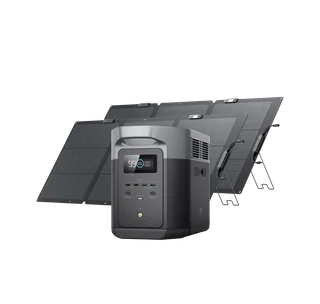
Check price: Bluetti Elite 200 V2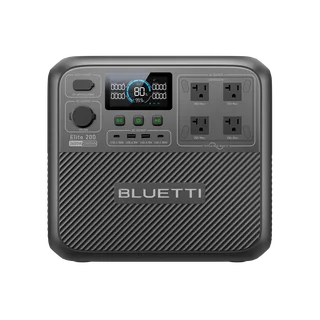 Check price: Ecoflow Delta 2 Max
Head to head
| Spec | BLUETTI Elite 200 V2 | EcoFlow DELTA 2 Max |
|---|---|---|
| Capacity | 2,073.6 Wh | 2,048 Wh |
| AC output (continuous) | 2,600 W | 2,400 W |
| Peak / surge (maker-rated) | 5,200 W | 4,800 W |
| Boost mode for resistive loads | 3,900 W (Power Lifting) | 3,100 W (X-Boost) |
| Battery | LiFePO4 | LiFePO4 |
| Rated cycles to 80% capacity | 6,000+ | 3,000 |
| Expandable | No | Yes - to 6,144 Wh with two extra batteries |
| Max solar input | 1,000 W | 1,000 W |
| Wall recharge to full | ~1.4 hrs | ~1 hr |
| Weight | 53.4 lb | 50 lb |
| Price (see note) | Around $899 | Around $1,029 |
| Cost per watt-hour (our math) | $0.43/Wh | $0.51/Wh |
Prices are manufacturers' published prices from our dataset, verified 2026-11-07 - not Amazon prices. Both brands discount aggressively and often, so treat the gap as "about $150 at last check," not a promise. Cycle ratings, weights, and boost figures are the manufacturers' own published specs, cross-checked on EcoFlow's and BLUETTI's pages on 2026-11-11. We compare published specs and prices only; we don't hands-on test.
Round by round
Capacity: draw. 2,073.6 Wh against 2,048 Wh is a 1% difference - inside the rounding of real-world usable capacity (plan on roughly 85% of either figure after inverter losses). Neither machine runs your fridge meaningfully longer than the other; we ran the refrigerator math for both in our Elite 200 V2 fridge runtime and DELTA 2 Max fridge runtime guides, and both land at about a day of typical fridge use.
Output: BLUETTI. 2,600 W continuous beats 2,400 W, and its maker-rated peak (5,200 W) tops EcoFlow's (4,800 W). Both boost modes - Power Lifting and X-Boost - work the same way: they lower voltage to push resistive loads like kettles and hot plates past the continuous rating. Neither is a substitute for surge capacity on a motor load, and on honest continuous watts the BLUETTI is ahead.
Charging: EcoFlow, narrowly. Both refill fast and both cap solar input at 1,000 W. On a wall outlet the EcoFlow finishes a full charge in about an hour against roughly 1.4 hours for the BLUETTI. That gap only matters in a generator-hybrid routine, where every minute of generator run time is noise and fuel; for overnight recharging between outage days, both are done long before you need them.
Portability: EcoFlow, barely. 50 lb against 53.4 lb. Both are two-hand carries that live on a closet floor and get wheeled or hauled to where they're needed; 3.4 lb won't change how either one gets used.
Expansion: EcoFlow, and it isn't close. The DELTA 2 Max takes up to two add-on batteries and reaches 6,144 Wh - triple its base size, enough to change what it can back up. The Elite 200 V2 has no expansion port. This is the single structural difference between the two machines, and it's the whole EcoFlow case.
Battery lifespan: BLUETTI, and it isn't close either. Both are LiFePO4, but BLUETTI rates the Elite 200 V2 at 6,000+ cycles to 80% capacity against EcoFlow's 3,000. Multiplied out, that's about 12.4 MWh of rated lifetime energy against about 6.1 MWh - at the dataset prices, roughly $72 per lifetime MWh for the BLUETTI against $171 for the EcoFlow. One honest caveat: if the station sits in a closet and cycles a few times a year during outages, neither battery will ever reach its cycle limit - calendar aging gets there first, and this round stops mattering. If the station cycles daily (off-grid cabin, solar self-consumption, full-time RV), it's the round that decides everything.
Value: BLUETTI. Less money up front ($899 vs $1,029), more capacity per dollar ($0.43 vs $0.50 per Wh), more output, and double the rated battery life. The EcoFlow's premium buys the expansion port and the faster full recharge - worth it only if you'll use them.
Score: BLUETTI takes output, lifespan, and value. EcoFlow takes expansion, charging, and portability. Capacity is a draw.
The verdict
Buy the
Check price: Bluetti Elite 200 V2if 2 kWh is the size you need - and for the standard essentials load, it is. You get the stronger inverter, the longer-rated battery, and the lower price, and the things you give up (expansion, a faster full recharge) are things a fixed-size buyer never touches. In our full power station roundup it's the best-value fixed unit in the class for the same reasons; head to head against its closest rival, the margin holds.
Pick the EcoFlow instead if...
- You might outgrow 2 kWh. A transfer switch planned, a well pump on the someday list, outages getting longer - the DELTA 2 Max is the only one of the two that can grow, to 6,144 Wh. Buying the sealed BLUETTI and replacing it later costs more than the $150 premium now.
- Your outage plan is generator-hybrid. Run a small generator for an hour to refill the station, then run the house quietly on battery. The EcoFlow's faster full recharge shortens every generator window.
- You catch it on a deep sale. Both brands discount constantly; if the DELTA 2 Max's street price drops to the Elite's level or below, its expansion option becomes free and the verdict flips.
FAQ
Which one runs a refrigerator longer?
Effectively a tie - the capacities differ by about 1%. Both keep a typical fridge cold for roughly a day of real use; the per-model math is in the fridge runtime guides linked above.
Can either of them run a 240V load, like a well pump?
No. Both are 120V-only. If 240V is on your list, the step-up class is the
Check price: Bluetti Apex 300or the
Check price: Ecoflow Delta Pro 3, both of which output 120/240V - and at that point the expandable EcoFlow architecture gets much more competitive.
Does the cycle-life gap matter for a closet backup unit?
Mostly no, and pretending otherwise would be overselling the winner. A station that cycles 10 times a year hits 3,000 cycles in three centuries; what actually ages it is time and storage conditions. The 6,000-cycle rating is real value for daily-cycling users and cheap insurance for everyone else - but it shouldn't be the reason a pure outage-backup buyer chooses between these two. Price and output should, and both point the same way.
Related guides
- Anker SOLIX F3800 Plus vs EcoFlow DELTA Pro 3
- EcoFlow DELTA 3 Plus vs Anker SOLIX C1000 Gen 2
- EcoFlow DELTA 3 vs EcoFlow DELTA 3 Plus
- EcoFlow DELTA 3 vs Jackery Explorer 1000 v2