Anker SOLIX F3800 Plus vs EcoFlow DELTA Pro 3
Quick answer
The Anker SOLIX F3800 Plus wins this one for most home-backup buyers. It puts out 6,000W max (240V outlet; 2,400W max on 120V outlets) against the EcoFlow's 4,000 W, runs its 120V and 240V outlets at the same time where the EcoFlow makes you pick one or the other, takes 3,200 W of solar against 2,600 W, and expands to nearly 27 kWh against about 12 kWh. It also costs $200 more on the list - $2,999.99 against $2,799 - and it is the only one of the two you can actually buy from its maker today: the DELTA Pro 3 was out of stock in every variant on EcoFlow's US store at our check. The EcoFlow is the better machine on wall-charging speed (0-80% in 50 minutes against under 3 hours), UPS switching (10 ms against 20 ms), and weight (113.5 lb against 136.7 lb), and it holds slightly more base capacity - but a backup unit you can't buy doesn't back anything up.
Check price: Anker Solix F3800 Plus Check price: Ecoflow Delta Pro 3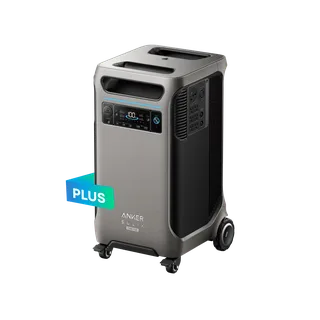
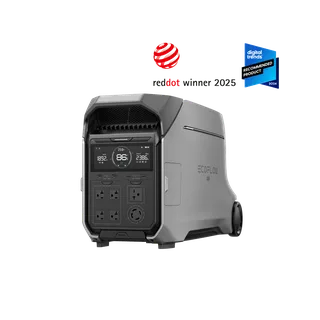
The two units, in order: Anker SOLIX F3800 Plus, EcoFlow DELTA Pro 3.
Head to head
| Spec | Anker SOLIX F3800 Plus | EcoFlow DELTA Pro 3 |
|---|---|---|
| Capacity | 3,840 Wh (see the capacity round) | 4,096 Wh |
| AC output | 6,000W max (240V outlet; 2,400W max on 120V outlets) | 4,000 W |
| Peak / surge (maker-rated) | None published | 8,000 W |
| Boost mode for resistive loads | None published - 6,000 W max is plain inverter output, not a boost mode | 6,000 W (X-Boost) |
| 240V output | Yes - L14-30R, simultaneous with 120V | Yes - L14-30R + 6-20R, but NOT simultaneous with 120V |
| Battery | LiFePO4 | LiFePO4 |
| Rated cycles | 3,000+ (retention threshold not stated) | 4,000 to 80% capacity |
| Expandable | Yes - 6 packs, to 26,880 Wh | Yes - 2 packs, to 12,288 Wh |
| Max solar input | 3,200 W (two ports, 11-165 V each) | 2,600 W (1,600 W high-PV 30-150 V + 1,000 W low-PV 11-60 V) |
| Wall recharge | Under 3 hrs (1,800 W input) | 0-80% in about 50 min |
| UPS switching | 20 ms | 10 ms |
| Noise | None published | As low as 30 dB |
| Weight | 136.7 lb (see the capacity round) | 113.5 lb |
| Price (see note) | Around $2,999.99 | Around $2,799 |
| Cost per watt-hour (our math) | $0.78/Wh | $0.68/Wh |
| Cost per watt of output (our math) | $0.50/W | $0.70/W |
Prices are the manufacturers' published prices from our dataset, re-verified on Anker's and EcoFlow's own product pages on 2026-11-19 - not Amazon prices. One price moved since our last check: the F3800 Plus was $2,399.99 and sold out on 2026-11-14; today it is $2,999.99 and in stock. The DELTA Pro 3's $2,799 is unchanged, but every variant - all 30 of them - was out of stock on EcoFlow's US store at the same check. We compare published specs and prices only; we don't hands-on test.
What the capacity buys you
Same runtime math as our Power Station Builder: usable AC energy is capacity x 0.85 after inverter losses, divided by the load's average draw.
| Load | Anker SOLIX F3800 Plus | EcoFlow DELTA Pro 3 |
|---|---|---|
| Full-size fridge (80 W average) | About 40.8 hrs | About 43.5 hrs |
| CPAP, no humidifier (11 W) | About 297 hrs - roughly 37 nights | About 317 hrs - roughly 40 nights |
| CPAP with humidifier and heated tube (56 W) | About 58 hrs - 7 nights | About 62 hrs - 7 nights |
| Space heater (1,500 W) | About 2.2 hrs | About 2.3 hrs |
| Well pump, 1/2 hp (670 W average) | About 4.9 hrs | About 5.2 hrs |
| Window AC, 10,000 BTU (820 W) | About 4.0 hrs | About 4.2 hrs |
On base capacity the EcoFlow runs everything a little longer - 256 Wh more is about 7% - but the gap is hours, not days, and it vanishes the moment either unit grows: fully expanded, the Anker runs a fridge about 286 hours (nearly 12 days) against the EcoFlow's 131 hours (about 5.5 days). See the expansion round.
Round by round
Capacity: EcoFlow, narrowly. 4,096 Wh against 3,840 Wh. The Anker's own pages disagree about its capacity - the Tech Specs say 3,840 Wh and 136.7 lb, while its FAQ answer on basic specifications says 3,480 Wh and 135.6 lb - and we record the Tech Specs figures, as with the Jackery capacity conflict on our DELTA 3 vs Explorer 1000 v2 page. Either way the EcoFlow holds a small edge here; it just isn't the round that decides this comparison.
Output: Anker, clearly. 6,000W max (240V outlet; 2,400W max on 120V outlets) against 4,000 W, and the difference is structural, not marketing: the EcoFlow's 6,000 W is X-Boost, a mode for resistive loads (heaters, kettles) that doesn't apply to motors and compressors, while the Anker's 6,000 W max is plain inverter output. The case that matters is a 240V well pump starting, or a window AC plus a fridge plus a microwave at once: the Anker carries them with headroom, the EcoFlow is at its ceiling. The EcoFlow's 8,000 W surge rating helps with motor starts, but Anker publishes no surge figure at all, so the two can't be compared on that line - another reason to judge the EcoFlow on its 4,000 W continuous figure.
240V: Anker, and this is the round that decides the purchase for transfer-switch buyers. Both units offer 240V from a single box, but they don't offer it the same way. The Anker runs its L14-30R (240V, 6,000 W max), its TT-30R (120V, 3,000 W), and its six 120V outlets all at once. The EcoFlow has two AC buttons and makes you choose: press 120V and the four 120V outlets plus the 30A RV outlet run while the 240V outlet is off; press 240V and the L14-30R plus a 6-20R run while every 120V outlet is off. If your plan is an inlet box or a manual transfer switch feeding both 120V circuits and a 240V well pump or water heater, the EcoFlow forces a choice the Anker doesn't. One Anker caveat, from its own FAQ: while the unit is recharging from a 120V wall outlet, the 240V outlet is unavailable - only the three 120V UPS outlets run.
Solar: Anker. 3,200 W against 2,600 W, and the port layout is the friendlier one: two identical 11-165 V MPPT ports at 1,600 W each, so one string design works on either port and the 165 V ceiling leaves headroom for cold-morning voltage rise. The EcoFlow splits its input into a high-voltage port (30-150 V, 1,600 W) and a low-voltage port (11-60 V, 1,000 W), which works but means planning two different strings. On a perfect solar day the Anker also refills faster: Anker claims a full recharge in under 2 hours in optimal sunlight on 3,200 W of solar.
Charging: EcoFlow, clearly. 0-80% in about 50 minutes on wall power, against under 3 hours for the Anker at its 1,800 W maximum AC input. In a generator-hybrid routine - run the generator, top the station, shut the generator off - the EcoFlow's shorter charge window is worth real fuel and real noise. The Anker's counter is its 6,000 W generator bypass: a 240V generator can feed straight through it during an extended outage, which the EcoFlow can't match.
Expansion: Anker, by a wide margin - on paper. Six BP3800 packs at 3,840 Wh each take a single Anker to 26,880 Wh; two DELTA Pro 3 packs at 4,096 Wh each take a single EcoFlow to 12,288 Wh. The catch is supply, and it cuts both ways: Anker's BP3800 was $1,999.99 and sold out at our 2026-11-19 check, with restock expected in about 30 days - so a full 27 kWh Anker costs $2,999.99 + 6 x $1,999.99 = about $15,000, and you can't buy the packs today. EcoFlow's DELTA Pro 3 pack ($1,899) is worse: sold out, and EcoFlow's own store says it will not be restocked. The fallback is the original DELTA Pro pack (3,600 Wh, $1,199), which EcoFlow confirms is compatible and can be mixed with the newer packs - but its US product page returned a 404 at our last check and only a refurbished version remains in the catalog. Our builder checks which batteries actually fit which station, because this is exactly where listings mislead.
Battery lifespan: EcoFlow. 4,000 cycles to 80% capacity, stated with the retention threshold, against Anker's "3,000+ cycles" with no threshold published. Both are LiFePO4 and both carry 5-year warranties. Multiplied out, the EcoFlow lands near 13 MWh of rated lifetime energy against the Anker's roughly 11.5 MWh - and the usual caveat applies: a station that cycles a few times a year in outages will die of calendar age long before it sees either number.
UPS and noise: EcoFlow. 10 ms switching against 20 ms - both are fast enough for most electronics, but the EcoFlow's 10 ms is the safer number for a NAS or a server, and it pairs with a published noise floor as low as 30 dB where Anker publishes no noise figure at all. The Anker's one counter here is its ~40 W AC idle draw, published in its own FAQ - worth knowing if you plan to leave it on standby for days, since 40 W around the clock is nearly 1 kWh a day before you plug anything in.
Portability: EcoFlow. 113.5 lb against 136.7 lb, and both have wheels and handles - but 23 lb is 23 lb when you're moving a box that size up a step or into a truck. Neither is a grab-and-go unit; the EcoFlow is simply the less punishing one to move.
Value: split. The EcoFlow is $200 cheaper on the list and cheaper per watt-hour ($0.68 against $0.78). The Anker is far cheaper per watt of output ($0.50 against $0.70) because its 6,000 W buys so much more capability. Which measure matters depends on the job: if you need watts, the Anker is the bargain; if you need watt-hours at the lowest price, the EcoFlow is.
Availability: Anker, and it isn't close. On 2026-11-19 the F3800 Plus was in stock at Anker's store at $2,999.99. The DELTA Pro 3 was out of stock in every variant on EcoFlow's US store - the station, the station-plus-battery bundle, the solar bundles, all of them. It remains listed on Amazon, but note the pattern from our other pages: a maker-sold-out unit is a unit you may have to hunt for, and its expansion packs are in worse shape than the station itself.
Score: Anker takes output, 240V, solar, expansion, and availability. EcoFlow takes capacity, charging, lifespan, UPS/noise, portability, and value-per-watt-hour.
The verdict
Buy the
Check price: Anker Solix F3800 Plusif this is a whole-home backup unit - the fridge, the well pump, the window AC, the transfer switch. It runs the bigger loads with headroom, feeds 120V and 240V circuits at the same time, takes more solar, and grows to nearly 27 kWh when your plans do. It is also, today, the one you can actually order from its maker. The $200 premium over the EcoFlow's list price buys 50% more output and a far higher expansion ceiling.
Pick the EcoFlow instead if...
- Wall-charging speed is the job. A generator-hybrid routine, or an outage where the grid comes back in short bursts: 0-80% in 50 minutes against under 3 hours is a real operational difference.
- You run sensitive electronics on UPS. 10 ms switching against 20 ms, a published 30 dB noise floor, and the lighter box all favor the EcoFlow - if you can find one in stock.
- Your loads are settled and modest. Fridge, lights, CPAP, a TV - nothing near 4,000 W and no 240V circuit to feed. Then the Anker's output and expansion are options you'll never exercise, the EcoFlow runs everything a little longer per charge, and it's $200 cheaper on the list. Our full power station roundup and the CPAP runtime guide cover the same math at smaller sizes.
FAQ
Can either of them run 120V and 240V loads at the same time?
The Anker can: its L14-30R, TT-30R, and 120V outlets all run together. The EcoFlow cannot on a single unit: its two AC buttons toggle between 120V mode and 240V mode, and the outlets on the other side switch off. This is the single biggest practical difference between the two, and it matters most if you feed a transfer switch or inlet box.
Which one charges faster from the wall?
The EcoFlow, by a lot: 0-80% in about 50 minutes. The Anker takes under 3 hours at its 1,800 W maximum AC input. The Anker closes the gap on solar (3,200 W input, full recharge in under 2 hours in optimal sunlight) and with its 6,000 W generator bypass during a long outage.
Can I expand either one later?
Yes, both - but check stock before counting on it. The Anker takes up to six BP3800 packs ($1,999.99 each) to 26,880 Wh; the packs were sold out at our 2026-11-19 check with restock expected in about 30 days. The EcoFlow takes up to two DELTA Pro 3 packs ($1,899 each) to 12,288 Wh, but those packs are sold out and EcoFlow says they will not be restocked; the fallback is the original DELTA Pro pack (3,600 Wh), whose US listing is itself down to refurbished units.
Is the DELTA Pro 3 discontinued?
EcoFlow hasn't said that. What we can verify: on 2026-11-19 every variant was out of stock on EcoFlow's US store, its extra battery is sold out with no restock planned, and it remains listed on Amazon. Treat it as a model you may have to hunt for rather than one you can always order maker-direct. The same pattern showed up on our DELTA 3 vs Explorer 1000 v2 page, where the sold-out unit was the Jackery.
What about the original Anker SOLIX F3800?
Anker has replaced it with the Plus: the F3800's product page now redirects to the Plus, its $2,199.99 price is no longer live, and only a refurbished F3800 page ($1,539.99, sold out) was clearly live at our last check. The Plus is the current model, with wider solar input (11-165 V against 11-60 V), a 240V generator connection, a TT-30R RV outlet the original lacked, and no 14-50R outlet. That is why this page compares the Plus.
Related guides
- EcoFlow DELTA 2 Max vs BLUETTI Elite 200 V2
- EcoFlow DELTA 3 Plus vs Anker SOLIX C1000 Gen 2
- EcoFlow DELTA 3 vs EcoFlow DELTA 3 Plus
- EcoFlow DELTA 3 vs Jackery Explorer 1000 v2