EcoFlow DELTA 3 vs EcoFlow DELTA 3 Plus
Quick answer
Buy the EcoFlow DELTA 3 Plus if you will ever recharge from the sun; buy the plain DELTA 3 if you won't, and keep the $120. The two are the same machine in every way that matters for wall-charged backup: 1,024 Wh, 1,800 W output, 27.6 lb, a 56-minute wall charge, a sub-10 ms UPS, and the same expansion port. The Plus doubles solar input to 1,000 W (two 500 W ports against one), which cuts a full solar recharge from about 2 hours to 70 minutes, and bumps the USB ports (140 W USB-C against 100 W, 36 W USB-A against 18 W). Everything else - capacity, output, weight, charging, warranty - is identical. This is the "which DELTA 3" question, and it has a one-line answer: solar, or no solar.
Check price: Ecoflow Delta 3 Check price: Ecoflow Delta 3 Plus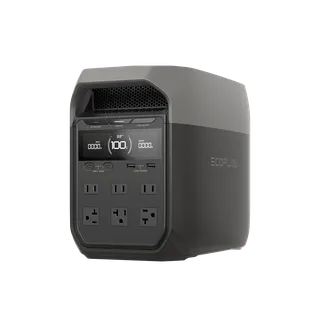
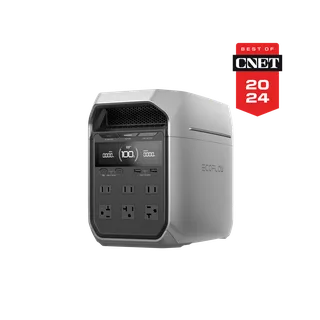
The two units, in order: EcoFlow DELTA 3, EcoFlow DELTA 3 Plus.
Head to head
| Spec | EcoFlow DELTA 3 | EcoFlow DELTA 3 Plus |
|---|---|---|
| Capacity | 1,024 Wh | 1,024 Wh |
| AC output (continuous) | 1,800 W | 1,800 W |
| Peak / surge (maker-rated) | 3,600 W | 3,600 W |
| Boost mode for resistive loads | 2,200 W (X-Boost, specs table - see the output round) | 2,200 W (X-Boost, specs table - see the output round) |
| Battery | LiFePO4 | LiFePO4 |
| Rated cycles | 4,000 to 80%+ capacity | 4,000 to 80%+ capacity |
| Expandable | Yes - to about 5 kWh with one add-on battery | Yes - to about 5 kWh with one add-on battery |
| Max solar input | 500 W (one XT60 port, 11-60 V) | 1,000 W (two ports, 11-60 V, 500 W each) |
| Wall recharge to full | About 56 min (standard charge) | About 56 min (standard charge) |
| Full solar recharge (maker claim) | About 2 hrs at 500 W | 70 min at 1,000 W |
| UPS | Under 10 ms | Under 10 ms |
| Noise | 30 dB under 600 W | 30 dB under 600 W |
| USB | USB-A 18 W x2, USB-C 100 W x2 | USB-A 36 W max, USB-C 140 W max |
| Weight | 27.6 lb | 27.6 lb |
| Price (see note) | Around $599 | Around $719 |
| Cost per watt-hour (our math) | $0.58/Wh | $0.70/Wh |
Prices are the manufacturers' published prices from our dataset, re-verified on EcoFlow's own product pages on 2026-11-20 - not Amazon prices. The DELTA 3's standard variant is $599 and in stock; note the price moved - $579 is now a members-only variant (with a free 65W charger), and our dataset is updated to the $599 standard price. The DELTA 3 Plus is $719 and in stock. We compare published specs and prices only; we don't hands-on test.
What the capacity buys you
Same runtime math as our Power Station Builder: usable AC energy is capacity x 0.85 after inverter losses, divided by the load's average draw. The two units have the same capacity, so this table has one column - the runtimes are identical.
| Load | Both units |
|---|---|
| Full-size fridge (80 W average) | About 10.9 hrs |
| CPAP, no humidifier (11 W) | About 79 hrs - roughly 10 nights |
| CPAP with humidifier and heated tube (56 W) | About 15.5 hrs - 2 nights |
| Space heater (1,500 W) | About 35 min, with output headroom |
Neither machine runs a fridge for multiple days or a space heater for an evening. The capacity round is a dead tie, which is the point of this page: the $120 buys solar and USB, not runtime.
Round by round
Capacity: dead tie. Same 1,024 Wh, same runtime table above. If you are choosing between these two, capacity should not enter into it at all.
Output: dead tie. Same 1,800 W continuous, same 3,600 W surge, same 2,200 W X-Boost for resistive loads. One wrinkle, logged in our dataset and worth knowing whichever you buy: EcoFlow's Specs table says X-Boost is 2,200 W while its page prose says "over 2,600 W" - we use the Specs table figure on both pages, as we did for the DELTA 3 vs Explorer 1000 v2 comparison. A 1,500 W space heater or kettle runs on either with 300 W to spare.
Solar: Plus, and it is the whole page. 1,000 W against 500 W, across two identical 11-60 V ports at 500 W each against the DELTA 3's single XT60 port. EcoFlow claims a full solar recharge in 70 minutes at 1,000 W against about 2 hours at 500 W. On a perfect solar day the Plus refills twice as fast, and its two-port layout takes two panel strings without fuss. If your outage plan involves recharging from the sun rather than the wall, this round alone is worth the $120. If your plan is wall charging plus a generator, the DELTA 3's single 500 W port is an option you'll never exercise.
Charging: dead tie. Both charge 0-100% from the wall in about 56 minutes at 1,500 W input, no mode-switching required. Both take an 800W car charge in about 1.3 hours. The only charging difference is the solar one above.
Portability: dead tie. Both 27.6 lb, same dimensions, same 13 output ports. In a class of machine that gets carried to campsites and up stairs, there is nothing to choose between them.
Expansion: dead tie, with the same caveat on both. Both take one add-on battery and, because EcoFlow's extra batteries are cross-model, that battery can be a DELTA 3, DELTA 2, DELTA 2 Max, or DELTA Pro 3 pack - up to about 5 kWh total with the largest. The same honest caveat applies to both: the largest compatible pack, the DELTA Pro 3 battery (4,096 Wh), is sold out and EcoFlow says it will not be restocked, the DELTA 2 Max pack ($899) was sold out at our last check, and the DELTA 3 Series pack has no standalone US listing - so treat "up to 5 kWh" as a ceiling, not a shopping list. One small difference in how you'd actually get the pack: the DELTA 3 + DELTA 3 Extra Battery bundle is $919 and in stock at EcoFlow today, while the DELTA 3 Plus + battery bundle is $1,119 and out of stock. Our builder checks which batteries actually fit which station, because this is exactly where listings mislead. One more wrinkle, flagged in our dataset: the Plus page states extra batteries connect "via an Alternator Charger XT150 Output Cable," while the DELTA 3 page doesn't state the cable requirement at all - EcoFlow's own pages disagree, so budget for the cable either way.
Battery lifespan: dead tie. Both LiFePO4 rated at 4,000 cycles to 80%+ remaining capacity, both with 5-year warranties. Multiplied out, both land near 4.1 MWh of rated lifetime energy. And the usual caveat applies: a station that cycles a few times a year in outages will die of calendar age long before it sees 4,000 cycles.
UPS and noise: dead tie. A sub-10 ms UPS and a published 30 dB noise floor under 600 W on both. If the station sits behind a computer or a NAS, or beside a bed, either is the same pick on paper.
USB: Plus, slightly. 140 W USB-C against 100 W, 36 W USB-A against 18 W. It matters if you fast-charge a laptop from the station; it doesn't matter for backup power. A $120 premium for USB alone would be a bad buy - it only counts as a tiebreaker on top of the solar.
CPAP: dead tie on math, one shared warning on owner evidence. On our math the two are identical - about 10 dry nights or 2 heated nights each. The owner data we have is one medium-confidence report on the DELTA 3 Plus: running "just the machine" for 8 hours on AC used about 45% of the pack - an implied full run of about 17.8 hours against 79 predicted - with the thread putting it down to the DELTA 3 family's high inverter idle draw on AC. We have no DELTA 3-specific report, and the thread frames the idle draw as a family trait, so the warning plausibly covers both - but it is a Plus measurement, not a DELTA 3 measurement, and we don't present it as one. The full per-setting tables are in our CPAP runtime guide and the CPAP calculator, and our CPAP owner-data page carries the report with its source.
Value: DELTA 3, clearly - unless you use the solar. $120 less up front and $0.58/Wh against $0.70/Wh for the same capacity, output, weight, and warranty. The Plus's premium buys exactly two things: double the solar input and faster USB. If you will use the solar, the premium pays for itself the first time the sun - not the wall - refills your station. If you won't, it's $120 for options you'll never exercise.
Availability: tie. On 2026-11-20 both are in stock at EcoFlow's US store at their standard prices ($599 / $719). The DELTA 3's $579 members-only variant is also available, if you're an EcoFlow member and want the free 65W charger with it.
Score: the Plus takes solar and USB. The DELTA 3 takes value. Everything else is a dead tie - which is why the verdict is one question long.
The verdict
Buy the
Check price: Ecoflow Delta 3 Plusif your outage plan includes recharging from the sun - a solar panel on the roof or in the yard, a multi-day outage where the wall is dead and the sun isn't. The 1,000 W solar input refills the station in 70 minutes against about 2 hours, and that is the difference between a station that keeps up with a fridge through a long outage and one that slowly falls behind.
Pick the DELTA 3 instead if...
- You recharge from the wall or a generator. Then the Plus's solar is an option you'll never exercise, and the DELTA 3 does the same job - same capacity, same output, same weight, same 56-minute charge - for $120 less.
- Your solar plan is a single small panel. A 100-200 W panel never fills either unit's solar input, so the Plus's second 500 W port buys nothing. Save the $120 and put it toward the panel.
- You already own a DELTA 3. There is no reason to switch: same capacity, same output, same everything except solar and USB. If you want more solar later, the money goes further as a second panel than as a second station.
FAQ
Is the DELTA 3 Plus just a DELTA 3 with more solar?
Mostly, yes - same 1,024 Wh, same 1,800 W output, same 27.6 lb, same 56-minute wall charge, same UPS, same warranty. The Plus doubles solar input to 1,000 W (two 500 W ports against one 500 W port) and bumps the USB ports. If you never recharge from the sun, the plain DELTA 3 at $599 does the same job for $120 less.
Why did the DELTA 3's price change from $579?
It didn't, quite: $579 is still a live price, but only as a members-only variant (with a free 65W charger). The standard DELTA 3 variant is $599 and in stock at EcoFlow's US store as of our 2026-11-20 check. We record the standard price in our dataset and state the members-only variant here so the two listings don't look like a contradiction.
Can either of them run a 240V load, like a well pump?
No. Both are 120V-only. The step up is a 240V-capable unit like the Jackery Explorer 5000 Plus vs EcoFlow DELTA Pro Ultra pair - a different size and price class entirely. For the smaller 240V pair, see our Anker SOLIX F3800 Plus vs EcoFlow DELTA Pro 3 page, where the EcoFlow makes you choose 120V or 240V while the Anker runs both at once.
Can either one expand to more capacity later?
Yes, both - one add-on battery, up to about 5 kWh total, from the same cross-model battery family (DELTA 3, DELTA 2, DELTA 2 Max, or DELTA Pro 3 packs). The caveat is the same for both: the biggest pack is sold out with no restock, so check pack stock before counting on the full 5 kWh. The DELTA 3 + battery bundle ($919) is in stock today; the Plus + battery bundle ($1,119) is out of stock.
Which one is better for a CPAP?
On the math, neither - identical capacity means identical runtimes, about 10 dry nights or 2 heated nights each. The one owner report we have (on the Plus) warns of high inverter idle draw on AC, and the thread frames it as a DELTA 3 family trait, so treat both with the same caution on AC and prefer the DC converter where your machine offers one. See our CPAP owner-data page for the report itself.
Related guides
- Anker SOLIX F3800 Plus vs EcoFlow DELTA Pro 3
- EcoFlow DELTA 2 Max vs BLUETTI Elite 200 V2
- EcoFlow DELTA 3 Plus vs Anker SOLIX C1000 Gen 2
- EcoFlow DELTA 3 vs Jackery Explorer 1000 v2