EcoFlow DELTA 3 vs Jackery Explorer 1000 v2
Quick answer
The EcoFlow DELTA 3 wins this one for home backup. The money is a wash - $579 against $559 - but the EcoFlow puts out 1,800 W against 1,500 W, takes 500 W of solar against 400 W, finishes a full wall recharge in about 56 minutes as its standard charge, and is the only one of the two that can grow: up to about 5 kWh with an add-on battery. The Jackery Explorer 1000 v2 is the better grab-and-go unit - nearly 4 lb lighter, $20 cheaper, and a touch more capacity on paper - with two catches we found in Jackery's own materials: its pages disagree about that capacity (1,070 Wh in the tech specs, 1,024 Wh in the headline copy), and Jackery's own store showed it sold out at our last check, steering buyers to a newer model.
Check price: Ecoflow Delta 3 Check price: Jackery Explorer 1000 V2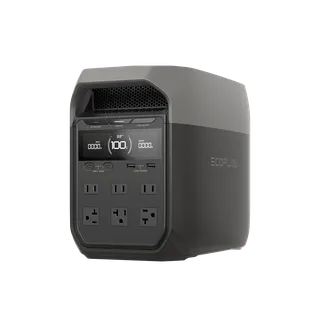
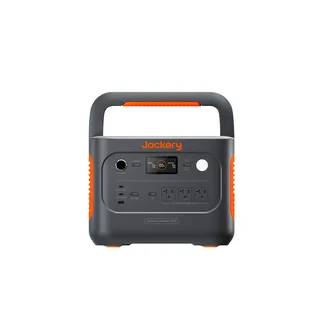
The two units, in order: EcoFlow DELTA 3, Jackery Explorer 1000 v2.
Head to head
| Spec | EcoFlow DELTA 3 | Jackery Explorer 1000 v2 |
|---|---|---|
| Capacity | 1,024 Wh | 1,070 Wh (tech specs - see the capacity round) |
| AC output (continuous) | 1,800 W | 1,500 W |
| Peak / surge (maker-rated) | 3,600 W | 3,000 W |
| Boost mode for resistive loads | 2,200 W (X-Boost) | None published |
| Battery | LiFePO4 | LiFePO4 |
| Rated cycles | 4,000 to 80%+ capacity | 4,000 (retention threshold not stated) |
| Expandable | Yes - to about 5 kWh with one add-on battery | No |
| Max solar input | 500 W (11-60 V, XT60) | 400 W (two DC8020 ports) |
| Wall recharge to full | About 56 min (standard charge) | About 50 min in Emergency Super Charge mode |
| Weight | 27.6 lb | 23.8 lb |
| Price (see note) | Around $579 | Around $559 |
| Cost per watt-hour (our math) | $0.57/Wh | $0.52/Wh at 1,070 Wh; $0.55 at 1,024 Wh |
Prices are the manufacturers' published prices from our dataset, re-verified on EcoFlow's and Jackery's own product pages on 2026-11-18 - not Amazon prices. Cycle ratings, weights, boost and charge-time figures are the manufacturers' own published specs, cross-checked the same day. One availability fact from that check: the DELTA 3 was in stock at EcoFlow; the Explorer 1000 v2 was sold out at jackery.com, with Jackery pointing buyers to its HomePower 1000 Plus v2 instead. It remains listed on Amazon. We compare published specs and prices only; we don't hands-on test.
What the capacity buys you
Same runtime math as our Power Station Builder: usable AC energy is capacity x 0.85 after inverter losses, divided by the load's average draw.
| Load | EcoFlow DELTA 3 | Jackery Explorer 1000 v2 |
|---|---|---|
| Full-size fridge (80 W average) | About 10.9 hrs | About 11.4 hrs (10.9 at 1,024 Wh) |
| CPAP, no humidifier (11 W) | About 79 hrs - roughly 10 nights | About 83 hrs - roughly 10 nights |
| CPAP with humidifier and heated tube (56 W) | About 15.5 hrs - 2 nights | About 16 hrs - 2 nights |
| Space heater (1,500 W) | About 35 min, with output headroom | About 36 min, at its absolute ceiling |
Round by round
Capacity: Jackery on paper, honestly a draw. Jackery's tech specs say 1,070 Wh (30.4 Ah at 35.2 V), and that is the figure we record in our dataset. But Jackery's own headline copy on the same product page says 1,024 Wh - exactly the DELTA 3's capacity - and its store copy has described a 1,024 Wh / 23.3 lb build before. We log the disagreement in our dataset's conflict list rather than silently picking one. At 1,070 the Jackery runs a fridge about half an hour longer; at 1,024 the two are identical. Either way, this round should not decide your purchase.
Output: EcoFlow, clearly. 1,800 W continuous against 1,500 W, a 3,600 W surge rating against 3,000 W, and an X-Boost mode rated to 2,200 W for resistive loads, which Jackery doesn't publish an equivalent for. The case that matters is a 1,500 W space heater or kettle: the DELTA 3 runs it with 300 W to spare, while the Jackery runs it at its absolute ceiling with nothing left for a second load. In the 1 kWh class, output is the round that decides what the box can actually do in an outage.
Solar: EcoFlow. 500 W of solar input against 400 W, in a single wide 11-60 V window on an XT60 connector - the connector most third-party panels and adapters use. The Jackery splits its input across two DC8020 ports with separate voltage bands, which is workable but fussier to feed from anything but Jackery's own panels. On a perfect solar day the EcoFlow also refills noticeably faster: 500 W into 1,024 Wh beats 400 W into 1,070 Wh.
Charging: EcoFlow, narrowly. The DELTA 3's roughly 56-minute full charge is its standard wall charge at 1,500 W input. The Jackery's roughly 50-minute figure needs its Emergency Super Charge mode, switched on in the app - its standard charge is slower. Both are fast enough that this round rarely decides anything; it only matters in a generator-hybrid routine, where a shorter standard charge means a shorter generator window.
Portability: Jackery, and it isn't close. 23.8 lb against 27.6 lb. In a class of machine that gets carried to campsites, up stairs, and out to the truck, nearly 4 lb is the difference you feel every single trip. If this box travels more than it sits, this round can outweigh everything above it.
Expansion: EcoFlow, by default. The DELTA 3 takes one add-on battery and, because EcoFlow's extra batteries are cross-model, that battery can be a DELTA 3, DELTA 2, DELTA 2 Max, or DELTA Pro 3 pack - up to about 5 kWh total with the largest. The Explorer 1000 v2 has no expansion port: the size you buy is the size you own. Our builder checks which batteries actually fit which station, because this is exactly where listings mislead.
Battery lifespan: draw. Both are LiFePO4 rated at 4,000 cycles. EcoFlow states its figure to 80%+ remaining capacity; Jackery's headline copy doesn't state the retention threshold, so the two 4,000s aren't perfectly comparable - but multiplied out, both land near 4.1-4.3 MWh of rated lifetime energy, roughly $131-141 per lifetime MWh at dataset prices. And the usual caveat applies: a station that cycles a few times a year in outages will die of calendar age long before it sees 4,000 cycles. This round matters to daily cyclers, and for them it's a tie.
Value: Jackery, narrowly. $20 less up front and fewer dollars per watt-hour either way you count its capacity ($0.52 at 1,070 Wh, $0.55 at 1,024 Wh, against $0.57). The EcoFlow's premium buys output, solar headroom, and the expansion port. The Jackery's discount is real but small - and it comes with the availability problem below.
Availability: EcoFlow. On 2026-11-18 the DELTA 3 was in stock at EcoFlow's store. The Explorer 1000 v2 was sold out at jackery.com in every variant - it has been, on and off, since at least our November 13 check - and Jackery's page sends buyers to the HomePower 1000 Plus v2. You can still find the 1000 v2 on Amazon, but note Jackery's own warranty terms: coverage runs only through its official site, branded platforms, or authorized dealers.
Score: EcoFlow takes output, solar, charging, expansion, and availability. Jackery takes portability and value. Capacity and lifespan are draws.
The verdict
Buy the
Check price: Ecoflow Delta 3if this is a home-backup unit first - the fridge, the CPAP, the lights, maybe a space heater in the room you're sheltering in. It runs the bigger loads with headroom, refills fastest from wall or sun, and it's the only one that can grow past 1 kWh when your plans do. In our full power station roundup the 1 kWh class is where buyers most often underbuy output; head to head, the DELTA 3 is the safer underbuy-proof pick, and it's the one actually on the shelf.
Pick the Jackery instead if...
- It travels. Camping, RV, tailgating, a cabin you carry gear into - at 23.8 lb the Explorer 1000 v2 is the one you'll actually bring, and a station left at home backs up nothing.
- Your loads are small and settled. Fridge, phones, lights, a CPAP - nothing near 1,500 W, and no expansion in your future. Then the EcoFlow's advantages are options you'll never exercise, and the Jackery does the same job for $20 less.
- You run a CPAP and count ounces. Both machines cover about 10 dry nights or 2 heated nights on our math - the full per-setting table is in our CPAP runtime guide and the CPAP calculator - so CPAP alone doesn't separate them; weight might.
FAQ
Which one runs a refrigerator longer?
On tech-spec capacity, the Jackery by about half an hour (11.4 vs 10.9 hours on an 80 W average fridge). On the capacity in Jackery's own headline copy, it's a dead tie at 10.9 hours. Plan on either machine covering a fridge through the night and into the next day, not multiple days.
Why do listings show two different capacities for the Jackery?
Because Jackery publishes two. Its tech specs give 30.4 Ah at 35.2 V, which multiplies out to 1,070 Wh; its headline copy and store descriptions say 1,024 Wh. We record the tech-spec figure in our dataset, flag the conflict there, and show the runtime and cost math both ways on this page so the disagreement can't quietly tilt the comparison.
Can either of them run a 240V load, like a well pump?
No. Both are 120V-only. The step up is a 240V-capable unit like the
Check price: Ecoflow Delta Pro 3or the Anker SOLIX F3800 - a different size and price class entirely.
Is the Explorer 1000 v2 discontinued?
Jackery hasn't said that. What we can verify: it was sold out at jackery.com on 2026-11-18 (and at our November 13 check), its product page promotes the HomePower 1000 Plus v2 as the in-stock alternative, and it remains listed on Amazon. Treat it as a model you may have to hunt for rather than one you can always order maker-direct.
Related guides
- Anker SOLIX F3800 Plus vs EcoFlow DELTA Pro 3
- EcoFlow DELTA 2 Max vs BLUETTI Elite 200 V2
- EcoFlow DELTA 3 Plus vs Anker SOLIX C1000 Gen 2
- EcoFlow DELTA 3 vs EcoFlow DELTA 3 Plus