Jackery Explorer 1000 v2 vs EcoFlow DELTA 3 Plus
Quick answer
The EcoFlow DELTA 3 Plus wins this one for home backup. Same 1,024 Wh class, but the EcoFlow puts out 1,800 W against 1,500 W, takes 1,000 W of solar against 400 W, has a 10 ms UPS the Jackery doesn't publish, and is the only one of the two that can grow - up to about 5 kWh with an add-on battery. It costs $160 more ($719 against $559) and weighs nearly 4 lb more. The Jackery Explorer 1000 v2 is the better grab-and-go unit - lighter, cheaper, and backed by the strongest owner CPAP data in the class - with one catch that keeps showing up: it was sold out at jackery.com at our check today, the third straight check, with Jackery steering buyers to its HomePower 1000 Plus v2 instead.
Check price: Jackery Explorer 1000 V2 Check price: Ecoflow Delta 3 Plus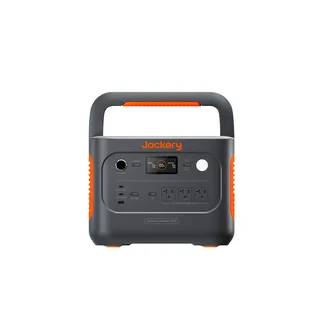
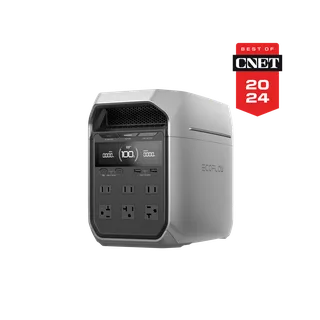
The two units, in order: Jackery Explorer 1000 v2, EcoFlow DELTA 3 Plus.
Head to head
| Spec | Jackery Explorer 1000 v2 | EcoFlow DELTA 3 Plus |
|---|---|---|
| Capacity | 1,070 Wh (tech specs - see the capacity round) | 1,024 Wh |
| AC output (continuous) | 1,500 W | 1,800 W |
| Peak / surge (maker-rated) | 3,000 W | 3,600 W |
| Boost mode for resistive loads | None published | 2,200 W (X-Boost, specs table - see the output round) |
| Battery | LiFePO4 | LiFePO4 |
| Rated cycles | 4,000 (retention threshold not stated) | 4,000 to 80%+ capacity |
| Expandable | No | Yes - to about 5 kWh with one add-on battery |
| Max solar input | 400 W (two DC8020 ports) | 1,000 W (two ports, 11-60 V, 500 W each) |
| Wall recharge to full | About 50 min in Emergency Super Charge mode | About 56 min (standard charge) |
| UPS | None published | Under 10 ms |
| Noise | None published | 30 dB under 600 W |
| Weight | 23.8 lb | 27.6 lb |
| Price (see note) | Around $559 | Around $719 |
| Cost per watt-hour (our math) | $0.52/Wh at 1,070 Wh; $0.55 at 1,024 Wh | $0.70/Wh |
Prices are the manufacturers' published prices from our dataset, re-verified on Jackery's and EcoFlow's own product pages on 2026-11-19 - not Amazon prices. The DELTA 3 Plus was in stock at EcoFlow at $719. The Explorer 1000 v2 was sold out at jackery.com at $559 - our third straight sold-out check for this model (November 13, November 18, November 19) - with Jackery pointing buyers to its HomePower 1000 Plus v2. It remains listed on Amazon. We compare published specs and prices only; we don't hands-on test.
What the capacity buys you
Same runtime math as our Power Station Builder: usable AC energy is capacity x 0.85 after inverter losses, divided by the load's average draw.
| Load | Jackery Explorer 1000 v2 | EcoFlow DELTA 3 Plus |
|---|---|---|
| Full-size fridge (80 W average) | About 11.4 hrs (10.9 at 1,024 Wh) | About 10.9 hrs |
| CPAP, no humidifier (11 W) | About 83 hrs - roughly 10 nights (79 at 1,024 Wh) | About 79 hrs - roughly 10 nights |
| CPAP with humidifier and heated tube (56 W) | About 16 hrs - 2 nights | About 15.5 hrs - 2 nights |
| Space heater (1,500 W) | About 36 min, at its absolute ceiling | About 35 min, with output headroom |
On capacity alone these two are a tie - and the owner data in the CPAP round below says the Jackery actually delivers its numbers more cleanly than the EcoFlow does on AC. The rounds that separate them are output, solar, and expansion, not capacity.
Round by round
Capacity: Jackery on paper, honestly a draw. Same story as our DELTA 3 vs Explorer 1000 v2 page: Jackery's tech specs say 1,070 Wh (30.4 Ah at 35.2 V), while its headline copy on the same product page says 1,024 Wh - exactly the DELTA 3 Plus's capacity. We record the tech-spec figure in our dataset and flag the conflict there. At 1,070 the Jackery runs a fridge about half an hour longer; at 1,024 the two are identical. Either way, this round should not decide your purchase.
Output: EcoFlow, clearly. 1,800 W continuous against 1,500 W, a 3,600 W surge rating against 3,000 W, and an X-Boost mode the Jackery doesn't publish an equivalent for. One wrinkle, logged in our dataset: EcoFlow's Specs table says X-Boost is 2,200 W while its page prose says "over 2,600 W" - we use the Specs table figure, as we did for the DELTA 3. The case that matters is a 1,500 W space heater or kettle: the DELTA 3 Plus runs it with 300 W to spare, while the Jackery runs it at its absolute ceiling with nothing left for a second load.
Solar: EcoFlow, and it isn't close. 1,000 W of solar input against 400 W, across two identical 11-60 V ports at 500 W each - against the Jackery's two DC8020 ports with separate voltage bands. EcoFlow claims a full solar recharge in 70 minutes at 1,000 W. On a perfect solar day the EcoFlow refills two and a half times faster, and its wide standard voltage window takes third-party panels without fuss. If your outage plan involves recharging from the sun rather than the wall, this round alone is worth the $160.
Charging: a draw, with an asterisk on each side. The Jackery's roughly 50-minute full charge needs its Emergency Super Charge mode, switched on in the app - its standard charge is slower. The EcoFlow's roughly 56-minute full charge is its standard wall charge at 1,500 W input, no mode-switching required. Both are fast enough that this round rarely decides anything; it only matters in a generator-hybrid routine, where a shorter standard charge means a shorter generator window.
Portability: Jackery, and it isn't close. 23.8 lb against 27.6 lb. In a class of machine that gets carried to campsites, up stairs, and out to the truck, nearly 4 lb is the difference you feel every single trip. If this box travels more than it sits, this round can outweigh everything above it.
Expansion: EcoFlow, by default. The DELTA 3 Plus takes one add-on battery and, because EcoFlow's extra batteries are cross-model, that battery can be a DELTA 3, DELTA 2, DELTA 2 Max, or DELTA Pro 3 pack - up to about 5 kWh total with the largest. The Explorer 1000 v2 has no expansion port: the size you buy is the size you own. One honest caveat: the largest compatible pack, the DELTA Pro 3 battery (4,096 Wh), is sold out and EcoFlow says it will not be restocked, the DELTA 2 Max pack ($899) was sold out at our last check, and the DELTA 3 Series pack has no standalone US listing - so treat "up to 5 kWh" as a ceiling, not a shopping list, and check pack stock before counting on it. Our builder checks which batteries actually fit which station, because this is exactly where listings mislead.
Battery lifespan: draw. Both are LiFePO4 rated at 4,000 cycles. EcoFlow states its figure to 80%+ remaining capacity; Jackery's headline copy doesn't state the retention threshold, so the two 4,000s aren't perfectly comparable - but multiplied out, both land near 4.1-4.3 MWh of rated lifetime energy. And the usual caveat applies: a station that cycles a few times a year in outages will die of calendar age long before it sees 4,000 cycles.
UPS and noise: EcoFlow. A sub-10 ms UPS and a published 30 dB noise floor under 600 W, where Jackery publishes neither. If the station sits behind a computer or a NAS, or beside a bed, the EcoFlow is the safer pick on paper.
CPAP: Jackery on owner evidence, EcoFlow on paper. On our math the two are identical - about 10 dry nights or 2 heated nights each. The owner data tells a different story. For the Jackery, three high-confidence reports land right on our presets: an AirSense 10 on AC with humidity on auto used 33% in about 6.75 hours (implied 20.5 hours full, against 20.7 predicted at our 44 W setting), and the same owner's DC night used about 25% less energy for a slightly longer night. For the DELTA 3 Plus, the one owner report we have is a warning: running "just the machine" for 8 hours on AC used about 45% of the pack - an implied full run of about 17.8 hours against 79 predicted - and the thread puts it down to the DELTA 3's high inverter idle draw on AC. One report, medium confidence, settings unspecified - but it matches the pattern our CPAP owner-data page already documents for this family, and it means the Jackery's CPAP numbers are the ones owners have actually reproduced. Two caveats: Jackery's own FAQ says its stations are not recommended for medical devices, and both machines' full per-setting tables are in our CPAP runtime guide and the CPAP calculator.
Value: Jackery, clearly. $160 less up front and fewer dollars per watt-hour either way you count its capacity ($0.52 at 1,070 Wh, $0.55 at 1,024 Wh, against $0.70). The EcoFlow's premium buys output, solar headroom, a UPS, and the expansion port. The Jackery's discount is real and large in this class - and it comes with the availability problem below.
Availability: EcoFlow. On 2026-11-19 the DELTA 3 Plus was in stock at EcoFlow's store. The Explorer 1000 v2 was sold out at jackery.com in every variant - it has been, on and off, since at least our November 13 check - and Jackery's page sends buyers to the HomePower 1000 Plus v2. You can still find the 1000 v2 on Amazon, but note Jackery's own warranty terms: coverage runs only through its official site, branded platforms, or authorized dealers.
Score: EcoFlow takes output, solar, expansion, UPS/noise, and availability. Jackery takes portability, value, and CPAP-on-owner-evidence. Capacity, charging, and lifespan are draws.
The verdict
Buy the
Check price: Ecoflow Delta 3 Plusif this is a home-backup unit first - the fridge, the CPAP, the lights, maybe a space heater in the room you're sheltering in. It runs the bigger loads with headroom, refills two and a half times faster from the sun, has the UPS and the expansion port, and it's the one actually on the shelf. In our full power station roundup the 1 kWh class is where buyers most often underbuy output and solar; head to head, the DELTA 3 Plus is the safer underbuy-proof pick.
Pick the Jackery instead if...
- It travels. Camping, RV, tailgating, a cabin you carry gear into - at 23.8 lb the Explorer 1000 v2 is the one you'll actually bring, and a station left at home backs up nothing.
- Your loads are small and settled. Fridge, phones, lights, a CPAP - nothing near 1,500 W, no solar recharging in your plan, and no expansion in your future. Then the EcoFlow's advantages are options you'll never exercise, and the Jackery does the same job for $160 less - if you can find one.
- You run a CPAP and trust owner data over spec sheets. The Jackery is the only one of the two whose CPAP runtimes owners have reproduced to the hour, on AC and on DC. The DELTA 3 Plus's one owner report points the other way.
FAQ
Which one runs a refrigerator longer?
On tech-spec capacity, the Jackery by about half an hour (11.4 vs 10.9 hours on an 80 W average fridge). On the capacity in Jackery's own headline copy, it's a dead tie at 10.9 hours. Plan on either machine covering a fridge through the night and into the next day, not multiple days. Our DELTA 3 vs Explorer 1000 v2 page works the same math for the non-Plus DELTA 3.
Why do listings show two different capacities for the Jackery?
Because Jackery publishes two. Its tech specs give 30.4 Ah at 35.2 V, which multiplies out to 1,070 Wh; its headline copy and store descriptions say 1,024 Wh. We record the tech-spec figure in our dataset, flag the conflict there, and show the runtime and cost math both ways on this page so the disagreement can't quietly tilt the comparison.
Can either of them run a 240V load, like a well pump?
No. Both are 120V-only. The step up is a 240V-capable unit like the Anker SOLIX F3800 Plus vs EcoFlow DELTA Pro 3 pair - a different size and price class entirely, and one where the 240V question has a real catch: the EcoFlow makes you choose 120V or 240V, while the Anker runs both at once.
Is the Explorer 1000 v2 discontinued?
Jackery hasn't said that. What we can verify: it was sold out at jackery.com on 2026-11-19 (and at our November 13 and November 18 checks), its product page promotes the HomePower 1000 Plus v2 as the in-stock alternative, and it remains listed on Amazon. Treat it as a model you may have to hunt for rather than one you can always order maker-direct.
Is the DELTA 3 Plus just a DELTA 3 with more solar?
Mostly, yes - same 1,024 Wh, same 1,800 W output, same 27.6 lb, same 56-minute wall charge. The Plus doubles solar input to 1,000 W (two 500 W ports against one 500 W port), which is the whole difference that matters: a full solar recharge in 70 minutes against a much slower one. If you never recharge from the sun, the plain DELTA 3 at $579 does the same job for $140 less - see our DELTA 3 vs Explorer 1000 v2 page for that comparison.
Related guides
- Anker SOLIX F3800 Plus vs EcoFlow DELTA Pro 3
- EcoFlow DELTA 2 Max vs BLUETTI Elite 200 V2
- EcoFlow DELTA 3 Plus vs Anker SOLIX C1000 Gen 2
- EcoFlow DELTA 3 vs EcoFlow DELTA 3 Plus